
Reflections on Peace, Philosophy, and Life
“Humanity’s greatest danger may not be change, but our habit of waiting until change becomes unavoidable.”
There is something remarkably comforting about doing nothing. We can convince ourselves that by remaining silent, avoiding confrontation or simply carrying on with our lives, we bear no responsibility for what happens around us. After all, we haven't actually done anything wrong, have we?
But when we witness injustice and remain silent, when we recognise dishonesty and excuse it, or when we see suffering and decide that it is somebody else's problem, are we genuinely innocent observers? Or have we become, however unintentionally, part of the conditions that allow these things to continue?
- Details
- Category: David's Blog
I have written four books exploring reality, awareness, change, responsibility, and the way we live with one another.
Each book is available in both English and German.
You can browse the editions here:
Books in English Bücher auf Deutsch
The books are:
Reality Is a Thought / Realität ist ein Gedanke
Human Beings Being Human / Menschen, die menschlich werden
The Book of Changes / Das Buch vom Wandel
Appeasement Then and Now / Beschwichtigung damals und heute
- Details
- Category: David's Blog
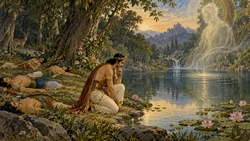
In the Mahabharata, there is a remarkable episode in which Yudhishthira finds his brothers lying apparently dead beside a lake. Before he may drink from the water, a mysterious being — the Yaksha — requires him to answer a series of questions. One of them is: “What is the greatest wonder?” Yudhishthira answers, in essence: “Every day people see others die, yet those who remain live as though they themselves were immortal. What could be more astonishing?”
It is difficult to imagine a more accurate description of the human condition. We know that we are going to die, not vaguely or theoretically, but with absolute certainty. Death is the one unavoidable fact that ultimately determines the shape of every human life. Our time is limited. Every possession, achievement, disappointment, grievance and ambition exists within that limit. Every relationship will end, and everything we accumulate will eventually belong to somebody else.
- Details
- Category: David's Blog

Credit and debit on the Swiss balance sheet
Switzerland has given the world humanitarian law, educational reform, scientific brilliance and remarkable public institutions. It has also excluded women, exploited vulnerable children, turned away refugees and mistreated migrants. Both accounts belong in the ledger—but responsibility belongs to people, parties and institutions, not to an imaginary national personality.
- Details
- Category: David's Blog

The phrase “know yourself” has been bandied about for centuries, at least. It sounds profound, but what does it actually mean?
Ask most people who they are and they will probably answer with a list. Their name, occupation, nationality, age, gender, family status, perhaps their interests, beliefs and achievements.
- Details
- Category: David's Blog
