
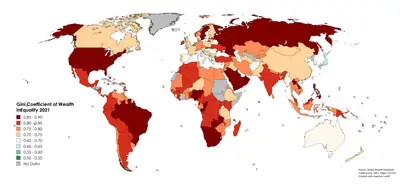
Crime and Poverty: Two Sides of the Same Coin
Crime and poverty are often discussed as if they were separate problems, requiring separate solutions. They are not. They are two sides of the same coin. And yet, again and again, societies attempt to eliminate crime while leaving poverty intact. This is not just ineffective — it is irrational.
If you want to reduce crime, you do not start with harsher laws, bigger prisons, or tougher policing. You start with poverty. Until poverty is addressed, crime will continue to regenerate itself, no matter how much force is applied to suppress it.
This is something lawmakers consistently fail to grasp — particularly those on the political right, who seem to believe that punishment alone can correct conditions that punishment itself helps perpetuate.
Poverty Is Not Inevitable
What makes this even more tragic is that poverty is entirely unnecessary.
There is enough food in the world.
Enough knowledge.
Enough technology.
Enough wealth.
What is missing is not supply, but distribution.
We live on a planet capable of providing for every human being, yet we tolerate — and even defend — systems that concentrate excess in a few hands while millions struggle for basic dignity. This is not an accident. It is the result of choices made by those in power, and sustained by structures designed to protect those choices.
And this brings us to the uncomfortable subject of justice.
The Illusion of Justice
Justice is often symbolised as blind — impartial, neutral, fair. In reality, this image is deeply misleading.
Man-made laws are created by those who hold power, and they are enforced by the same forces. The system is not blind at all; it sees very clearly who it serves. Poverty is criminalised, while structural greed is normalised. Survival becomes an offence, while exploitation is rewarded.
To call this “justice” is to twist the word until it no longer resembles its meaning.
Approaching the Edge
As another year comes to an end, the imbalances are not shrinking — they are accelerating. Wealth concentration increases. Social cohesion erodes. Ecological systems strain. Trust collapses.
It does not require much imagination to see where this leads. Five years may be enough to tip the system into undeniable global chaos. And the most painful part is this: none of it is necessary.
It is all driven by illusion — the illusion of endless growth, the illusion of separation, the illusion that accumulation equals security. Greed feeds on these illusions, while blindness to consequence allows them to persist.
There is little understanding of how rare life is in the universe, how fragile consciousness is, or how brief our individual time here truly is.
A Different Starting Point
The only consistently positive counterpoint I know comes from the message of Prem Rawat — not because it offers ideology or solutions imposed from above, but because it points inward.
The message is disarmingly simple:
Know thyself.
Recognise what a precious gift life is.
Understand that each of us is here for a very short time.
From that understanding, responsibility arises naturally. Compassion does not need to be legislated. Justice no longer depends on punishment, but on recognising shared humanity.
Perhaps the real revolution does not begin in parliaments or courtrooms, but in awareness — in seeing clearly, without illusion, what life is worth.
And once that is understood, poverty, crime, and injustice are no longer abstract problems. They become personal responsibilities.

Add comment