
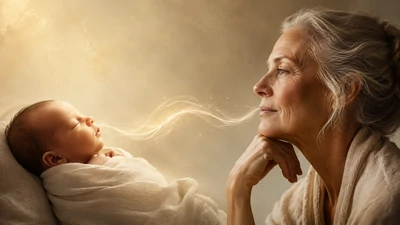
The phrase “know yourself” has been bandied about for centuries, at least. It sounds profound, but what does it actually mean?
Ask most people who they are and they will probably answer with a list. Their name, occupation, nationality, age, gender, family status, perhaps their interests, beliefs and achievements.
“I’m a retired teacher.”
“I’m Swiss.”
“I’m married.”
“I’m a father.”
“I’m seventy years old.”
“I’m a musician.”
All of these things may be perfectly true, but are they really an answer to the question Who am I?
Most of them are descriptions of circumstances. And circumstances change.
We change jobs. We marry or divorce. We become parents and grandparents. We move from one country to another. Our bodies grow, mature and age. Our political and religious ideas may alter completely. Things that once seemed terribly important to us may later seem almost irrelevant.
Even some of the characteristics we tend to think of as fundamental are not necessarily as straightforward as we once assumed. Gender is an obvious example. When I studied psychology in the 1970s, gender was already understood as involving more than simply genital anatomy. Today the distinction between biological sex, gender identity and social roles has become far more visible and openly discussed.
Yet through all these changes there remains the extraordinary sense that I am still me.
The child I was is gone. Physically, almost nothing of that child remains. His knowledge was different, his fears were different, his ambitions were different. The world he inhabited was different. And yet when I remember being that child, I don't think of him as somebody else.
I say, “When I was a child…”
That little word I is interesting.
What exactly does it refer to?
There seems to be something at the centre of our experience which remains present while everything else changes. It notices the changes. It experiences the body growing older. It experiences happiness and disappointment, success and failure, love and loneliness. Thoughts come and go. Emotions come and go. Opinions change. Yet there is continually this sense of being the one to whom all these things are happening.
We call that consciousness, awareness, the self, the observer, the experiencer — although each of those words carries its own philosophical baggage.
Perhaps the word itself matters less than the experience.
At birth we begin to acquire identifiers. We are given a name. Others identify us as male or female. We acquire a nationality, a language, a family history and, eventually, ideas about who we are supposed to be.
But none of that is there in the beginning.
A newborn baby does not know its name. It does not know what country it has been born in. It does not know its religion, social class or nationality. It cannot describe itself as clever, shy, successful, attractive or unsuccessful.
Language comes later.
Before language there is experience.
Warmth. Cold. Hunger. Comfort. Pain. Touch. Sound. Light. The presence or absence of another human being.
There is awareness before there is a story about the person who is aware.
As we grow, the story becomes increasingly elaborate. We learn our name and begin to respond to it. We learn what other people think of us. We discover what earns praise and what attracts criticism. We accumulate successes, failures, labels and expectations.
Gradually, the description can become so detailed that we begin to mistake it for the person being described.
Perhaps this is where “know yourself” becomes interesting.
It may not mean compiling an increasingly accurate psychological inventory of ourselves. Knowing that I am introverted rather than extroverted, impatient rather than patient, optimistic rather than pessimistic may be useful. But those are still descriptions of tendencies. They are things about me.
Knowing yourself may require a different question.
Not: What am I like?
But: What is it that is aware that I am like this?
And there is one extraordinarily simple reminder of this life that accompanies us every moment, mostly unnoticed.
Breath.
We breathe thousands of times every day, usually without giving it a thought. It is so ordinary that it hardly seems worth noticing. Yet without it, everything else becomes irrelevant very quickly.
No breath, no life.
We worry about money, relationships, possessions, status, politics, tomorrow’s appointments and next year’s plans. Meanwhile, this quiet movement continues: breath comes in, breath goes out. Again and again.
We take it completely for granted, precisely because it is always there.
Until it isn’t.
A moment of breathlessness changes our priorities immediately. Suddenly, nothing is more important than the next breath. And there may come a point in life when a person becomes aware that the breaths remaining are no longer countless. There are only so many more.
That can sound morbid, but I don't think it needs to be.
Quite the opposite.
The fact that breath is limited is what makes it valuable. Every breath is evidence that, at this particular moment, I am alive.
I do not have to believe anything for that to be true. I don't need a philosophy, a religion or a theory of consciousness. I can simply notice it.
A breath comes.
I am here.
Another breath comes.
I am still here.
Perhaps this is one reason we so easily lose touch with ourselves. We are fascinated by everything that has been added to life and overlook the life underneath it.
The name matters. The family matters. The work matters. Our responsibilities matter. The world around us certainly matters.
But all of those things are possible only because this life is here first.
Even consciousness itself, whatever ultimately causes it, is dependent upon this living body. It began, as far as I can know, with this life, and one day it will end with it.
That makes the question “Who am I?” less theoretical than it first appears.
I am not merely the collection of labels I have accumulated.
I am also this living, conscious human being, here now, receiving another breath.
And perhaps knowing yourself begins not by finding some complicated hidden answer, but by paying attention to what has been present all along.

Add comment