
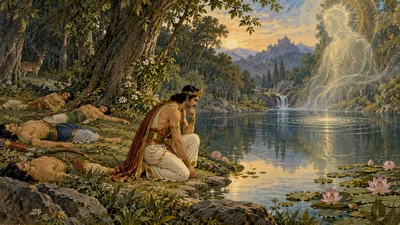
In the Mahabharata, there is a remarkable episode in which Yudhishthira finds his brothers lying apparently dead beside a lake. Before he may drink from the water, a mysterious being — the Yaksha — requires him to answer a series of questions. One of them is: “What is the greatest wonder?” Yudhishthira answers, in essence: “Every day people see others die, yet those who remain live as though they themselves were immortal. What could be more astonishing?”
It is difficult to imagine a more accurate description of the human condition. We know that we are going to die, not vaguely or theoretically, but with absolute certainty. Death is the one unavoidable fact that ultimately determines the shape of every human life. Our time is limited. Every possession, achievement, disappointment, grievance and ambition exists within that limit. Every relationship will end, and everything we accumulate will eventually belong to somebody else.
And yet we organise our lives as though this fact were almost irrelevant. We plan years ahead. We postpone things that matter. We remain angry for decades. We worry about status, money, recognition, success and failure. We tell ourselves that one day we will do the things we really want to do, speak to the person we have neglected, repair the relationship, travel somewhere, learn something, or simply find the time to live differently. “One day” is one of our most persistent illusions.
There is another side to this, and that is the question of why we find it so easy to forget the brevity of our lives. Another observation, often attributed to Arthur Schopenhauer, says: “Five minutes after birth, they decide your name, religion, nationality and sect. And you spend the rest of your life defending what you did not choose.” Whether Schopenhauer actually said those precise words is doubtful, but the observation itself points toward something important.
From the moment we are born, the world begins telling us what matters. We are given a name. We are assigned a nationality. We inherit a language, a culture, a religion or absence of religion, ideas about success and failure, ideas about respectability, ideas about what we should desire and what we should fear. None of this begins with our own conscious choice. Before we are old enough to question anything, we have already absorbed an enormous structure of assumptions about what life is supposed to be.
We learn that education matters, career matters, money matters, property matters, social standing matters, belonging matters, being admired matters, winning matters and being right matters. Because everyone around us appears to accept these things, they begin to seem self-evidently important. This conditioning need not be deliberate or sinister. Parents pass on what they themselves were taught. Schools prepare children for the society into which they have been born. Religions, governments, advertising, media and social customs reinforce particular ideas of identity and success.
The result is something much more powerful than simple instruction. It is distraction. Our attention becomes filled with almost everything except the fact that we are alive. We spend our lives dealing with things that appear urgent because we have been taught that they are important: whether we have enough, whether other people approve of us, whether we have achieved enough, whether our group is winning, whether someone has insulted us, whether we are keeping up, whether we are falling behind. And while all this is happening, life itself is passing.
Even if we were to live to be 100 — something most of us will not do — that would amount to only 36,500 days. That sounds like a large number until one begins to think about how many of those days have already gone, how many are spent sleeping, working, travelling, worrying, recovering from illness, carrying out obligations, or simply being distracted. Suddenly a human life does not seem long at all.
And that is what is really being wasted when we ignore the miracle of our own lives. Not merely time in the abstract, but actual days: mornings, conversations, meals, walks, friendships, chances to notice where we are and what it means to be here at all. We speak of “killing time” as though time were something separate from us, but the time we are killing is our life.
Perhaps that is the deeper connection between Yudhishthira's answer and the quotation attributed to Schopenhauer. The first points to our extraordinary blindness to death. The second suggests how easily our attention can be captured by identities, beliefs and priorities that were handed to us before we were capable of examining them. Put the two together and something uncomfortable appears: we know that our lives are short, but we have been trained from birth to devote enormous amounts of those short lives to things whose importance we rarely stop to question.
That may be one of the strangest things about being human. It is not simply that we forget death. We are distracted from life. To remember that we will die is not necessarily morbid; it can do precisely the opposite. It can restore proportion. If I genuinely understand that my time is limited, does an argument from ten years ago still deserve another afternoon of my life? Does somebody else's opinion of me deserve so much attention? How important is status? How important is winning an argument? How many hours of a finite life should be spent trying to impress people whose lives are equally finite?
This does not mean abandoning responsibility, refusing to plan for the future or pretending that money, work and practical matters are irrelevant. They are part of life. The problem begins when they become substitutes for it. Perhaps this is why death is such an uncomfortable subject: to take death seriously is to ask awkward questions about life.
If I had unlimited time, almost any postponement could be justified. But I do not, and neither do you. That fact changes the value of things. A conversation becomes more precious because there will only be a finite number of them. An ordinary meal matters because there will eventually be a last one. A morning matters. A friendship matters. A walk matters. A moment of quiet matters. Not because these things are grand achievements, but because they are life itself.
We have become extraordinarily skilled at filling time. Perhaps the more important question is what we are filling it with. Yudhishthira's answer reminds us that we somehow know we will die while living as though we will not. The observation attributed to Schopenhauer reminds us how much of what occupies the interval between birth and death was handed to us before we ever had the opportunity to choose.
Between those two thoughts lies a question worth asking: how much of what I call my life have I actually chosen, and how much of it is simply distraction? Perhaps the tragedy is not that life is short, but that we can spend so much of it forgetting that we are alive.

Add comment