
We like to think of ourselves as individuals. We like to think that our opinions are our own, that our decisions are based on reason, and that we are not easily influenced by others. Yet much of human behaviour suggests otherwise. Again and again, people move together, fear together, blame together and repeat the same explanations together.
We are social animals, and there is safety in belonging to the herd. Standing apart requires effort. It can also be uncomfortable, because once we stop following the herd, we may have to ask questions that do not have convenient answers. Why do I think this? Who told me this? What evidence have I actually examined? Who benefits from my fear? It is usually much easier simply to follow the animal in front.
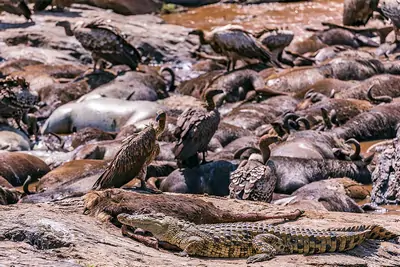
Anyone who has watched films of wildebeest crossing a crocodile-infested river will recognise the power of herd behaviour. Thousands of animals gather at the riverbank. Those at the front hesitate. They can probably sense the danger. They may see the crocodiles or smell the fear of the animals around them. Then one animal moves, another follows, and within seconds the entire herd is rushing into the water.
Some are swept away. Some are trampled. Some are caught by crocodiles. Yet the animals behind continue to jump into the same river because the movement of the herd has become more powerful than the danger in front of them.
Human beings are more intelligent than wildebeest. At least, that is what we tell ourselves. But are we always so different?
Our river crossings take the form of elections, referendums, political campaigns, newspaper headlines and public panics. One person begins to move, another follows, and soon a whole population is repeating the same words. Foreigners are the problem. The population is too large. Climate change is exaggerated. The experts are lying. They are taking what belongs to us.
The phrases are repeated so often that they begin to sound like established facts. Very few people stop to ask what they actually mean, whether they are true, or who has an interest in having them repeated.
The Comfort of “Not My Problem”
One of the easiest ways to avoid responsibility is to decide that something does not concern us. Climate change is a good example. People say that the worst effects will happen in the future, somewhere else, to people who have not yet been born. In any case, one person cannot change anything, so it becomes possible to continue living exactly as before.
But the future is not a separate place. It arrives one day at a time, and the children who will live with the consequences of today’s decisions are already alive. Floods, fires, droughts, damaged harvests and displaced populations are not theoretical events waiting in some distant century. They are already happening to real people.
More importantly, this is the only planet we have. There is no alternative Earth waiting for us once we have made this one uninhabitable. Climate is not somebody else’s business because nobody lives outside it. The air, water, soil, weather systems and oceans upon which life depends do not stop at national borders, and they do not distinguish between rich and poor, native and foreigner, left and right.
Climate is quite literally everybody’s business because it is the shared condition of life on Earth.
Yet as long as the suffering remains far enough away, it can be treated as a statistic. So many hectares burned. So many homes destroyed. So many people displaced. So many degrees of warming. The numbers may be alarming, but they do not have faces.
A statistic does not cry. It does not lose its home, hold a frightened child or wonder where the next meal will come from. Only people do that.
Ten Million People
The same reduction takes place in discussions about population and immigration. Switzerland is currently debating whether the population should be prevented from rising beyond ten million. Ten million sounds like a frighteningly large number. It is easy to place on a poster, repeat in a speech and turn into a political slogan.
But what exactly are ten million people?
They are nurses, builders, cleaners, engineers, cooks, carers, teachers, children, pensioners and families. They are people who were born here and people who arrived later. They are people fleeing war and people recruited because the economy needed workers. They are people who pay taxes, rent homes, care for the elderly and perform work that others are unwilling or unable to do.
Of course, population growth creates real problems. Housing, transport, schools, hospitals and infrastructure all have limits, and these matters need serious planning. But serious planning is not the same as finding someone to blame.
The moment the discussion becomes “the foreigners are the problem,” thought has stopped. A complicated situation has been reduced to a convenient enemy. It is much easier to blame foreigners than to ask why housing has become unaffordable, why planning has failed, why public transport is overcrowded, why wages have stagnated or why permanent economic growth is treated as an unquestionable necessity.
The foreigner becomes the crocodile in the river, and the herd is told to be afraid.
Statistics Without Human Beings
Statistics are necessary. Without them, governments could not plan hospitals, schools, housing or transport. Statistics can reveal injustice, inequality and danger. The problem begins when numbers replace the people they are supposed to describe.
A person becomes a migrant. A family becomes a household. Someone without work becomes an unemployment figure. A refugee becomes an asylum case. A dead civilian becomes a casualty. A child becomes part of a poverty percentage, and a human life becomes an entry in a database.
Once this has happened, it becomes much easier to speak harshly. We would hesitate to tell a frightened mother standing in front of us that she is an unacceptable burden. It is much easier to say that asylum numbers must be reduced. We might find it difficult to look into the eyes of someone whose village has been destroyed by drought and say that climate change is none of our business. It is much easier to discuss migration flows.
Language creates distance, and statistics can increase it. People are not statistics, although they are frequently treated that way.
The Manufacture of the Herd
Herd mentality does not always arise by accident. It can be encouraged. Politics depends heavily on the ability to simplify, because complicated problems do not fit easily onto posters or into short television interviews. Fear is quicker. Blame is clearer. An enemy is easier to understand than a system.
The media also depend on attention. A careful explanation of demographic change is less dramatic than a headline warning that the country is being overwhelmed. Numbers are selected because they appear objective. A number looks like a fact, but a number without context can be made to say almost anything.
We may be told how many foreigners live in a country, but not how many hospitals, care homes, construction sites and businesses depend upon them. We may be told how much immigration costs, but not how much tax immigrants contribute. We may be shown a dramatic increase over one particular year, but not the longer historical pattern. We may be told how many people are arriving, but not why they are leaving their homes.
The statistic may be accurate, while the story built around it is misleading. This is how the herd is guided, not necessarily through outright lies, but through repetition, selection and emotional framing. A frightening number is presented, a group is identified, a simple explanation is offered, and the herd begins to move.
There is another part of the wildebeest image that should not be overlooked. The crocodiles are not the only creatures that benefit from the crossing. Once an animal has been killed, vultures gather around the carcass. The herd takes the risk and suffers the losses, while others feed on the result.
Human societies are not so different. Fear may be spread among the population, but those who spread it often gain something from it: votes, influence, newspaper sales, online attention, advertising revenue or political power. Ordinary people are encouraged to fear one another, while those who created or amplified the panic remain safely on the riverbank.
The herd follows. The herd suffers. Others feast.
Selective Belief
There is a strange contradiction in the way people respond to statistics. Climate statistics are dismissed because they concern probabilities, models and the future, while population statistics are accepted immediately when they confirm fears about immigration. Scientific evidence gathered over decades is treated as uncertain, while a number on a political poster is treated as obvious truth.
The difference is not necessarily the quality of the statistics. The difference is often the story people want to hear. We accept numbers that support what we already feel and reject numbers that require us to change.
Climate change asks us to examine our way of life, our consumption, our energy use and our responsibility towards future generations. Blaming foreigners asks almost nothing of us. It allows us to remain exactly as we are while placing responsibility somewhere else. That is why it is so attractive.
The Individual Disappears
The most dangerous phrase in herd thinking is “those people.” Those people are not like us. Those people are taking advantage. Those people do not belong. Those people are responsible.
Once a population has been turned into “those people,” individuals disappear. There is no longer a woman caring for elderly residents in a nursing home, only a foreign worker. There is no longer a man who fled a war and is trying to rebuild his life, only an asylum seeker. There is no longer a child who speaks two languages and has never known another home, only someone with a migration background.
The category replaces the person, and when the person disappears, compassion usually disappears with them.
Stepping Out of the Herd
It is easy to criticise herd mentality in others. It is much harder to recognise it in ourselves. All of us are influenced by repetition, fear and the need to belong. None of us is entirely independent. We absorb assumptions from our families, our communities, our politics and our media.
The question is not whether we belong to a herd. The question is whether we are conscious of it.
Can we stop at the riverbank long enough to look at where the herd is going? Can we ask whether the danger is really in the river, or whether someone is deliberately frightening us from behind? Can we look beyond the number and see the person it conceals?
Consciousness begins when we stop repeating “they” and begin looking at the individual. This is one person. This is one life. This person feels fear, hope, love, pain and uncertainty just as I do.
A statistic can describe a group, but it cannot describe a human being. The herd always speaks in the plural: they are coming, they are taking, they are the problem.
Humanity begins with the singular.
Here is a person.
And here am I.
I may not be able to stop the herd, but I do not have to surrender my humanity to it.

Comments