
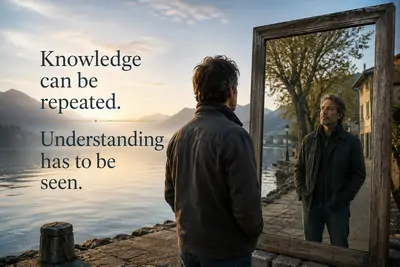
There is a difference between knowing something and understanding it. Knowledge can be collected, repeated, and defended. Understanding begins when we become aware of what is actually moving us inside — our fear, habits, assumptions, and inherited beliefs.
There is a difference between knowing something and understanding it. At first glance, that sounds obvious. But in everyday life the difference is not always easy to see, because knowledge can be very impressive. A person can quote facts, remember phrases, repeat ideas, use the right language, and appear to know what they are talking about. They may have read the book, watched the video, attended the course, heard the explanation, and stored the information. But that does not necessarily mean they understand.
Knowledge can be collected. Understanding has to be seen.
A person may know that smoking is harmful and still smoke. They may know that anger damages relationships and still explode over nothing. They may know that jealousy is painful and still feed it. They may know that the planet is under pressure and still say, “Climate change is not my business.” They may know that life is short and still waste much of it in resentment, comparison, fear, or the endless attempt to impress other people. So what is missing? Not information. Not necessarily intelligence. Often what is missing is awareness.
I recently came across a definition of unconsciousness: a state in which a living individual exhibits a complete, or near-complete, inability to maintain an awareness of self. Medically, of course, that refers to a person who is physically unconscious. But there is another kind of unconsciousness that is much more common. A person can be awake, active, informed, opinionated, even articulate — and still have very little awareness of what is actually moving them inside. They may know the words, but not the mechanism. They may know the slogan, but not the fear behind it. They may know the belief, but not where it came from. They may know the answer, but not themselves.
This is where knowledge without understanding becomes dangerous. Not because knowledge itself is dangerous, but because it can give a person the feeling that they have arrived when they have not even begun to look.
A simple example is anger. Most people know anger is unpleasant. They know it can hurt others. They know it can spoil a day, damage a friendship, or make a small situation much worse. But when anger comes, knowledge is often not enough. The person who knows all about anger may still be completely taken over by it. Understanding begins when I can see anger as it is happening. Not as a theory. Not afterwards, when I am explaining myself, but in the moment itself. I can feel the heat rising, the body tightening, the story forming in the mind: “I am right. They are wrong. I must defend myself. I must attack.” At that point, something new becomes possible. Not because I have more knowledge, but because I have awareness.
The same is true of fear. Prem Rawat makes a useful distinction between fear, phobia, and caution. A phobia may need professional help. Caution is sensible. If a car is coming, step back. If the road is icy, walk carefully. If something is genuinely dangerous, pay attention. But fear is something else. Fear often has a history. Behind fear there is usually something we have absorbed, something repeated, something planted so deeply that we no longer question it.
That is one way to understand indoctrination. Something is repeated again and again until it is no longer examined. It becomes part of the furniture of the mind. We do not experience it as an idea we have accepted; we experience it as reality. This can happen in religion, politics, culture, family, education, advertising, and even in supposedly spiritual environments. It can happen anywhere repetition replaces seeing.
A child hears often enough that success means money, and later may spend a life chasing money without ever asking whether it brings fulfilment. A person hears often enough that people from another group are dangerous, lazy, inferior, or strange, and later may call that prejudice “common sense.” Someone hears often enough that they are not good enough, and years later that voice is still active inside them, although the original speaker may be long gone. Another person hears often enough that loyalty means never questioning, and later mistakes obedience for love. In all these cases, the person may have knowledge. They may have explanations. They may even have arguments. But do they have understanding?
Understanding asks a harder question: what is actually going on in me?
Even something as ordinary as looking in the mirror before going out can reveal this. What am I checking? Am I seeing whether I feel comfortable, clean, appropriate, and at ease in myself? Or am I already imagining the eyes of others? Am I dressing for the weather, the occasion, and my own sense of dignity — or am I dressing for approval, comparison, attraction, status, or fear of judgement? The point is not that there is only one correct answer. We all live among other people, and there is nothing wrong with being considerate or presentable. But the mirror can become a small moment of honesty. Am I choosing, or am I being quietly driven?
This is where choice enters. Not the shallow kind of choice between one opinion and another, but the deeper choice: do I want to understand, or do I want to go back to the comfort of repetition? Because indoctrination has a strange comfort. It removes responsibility. If I simply repeat what I was told, then I do not have to look. If I belong to a group that confirms my views, I do not have to question them. If fear is guiding me, I can call it realism. If habit is guiding me, I can call it tradition. If anger is guiding me, I can call it honesty.
Understanding disturbs all that. It does not let me hide quite so easily. It asks: Is this true, or have I only heard it often? Is this caution, or is this fear? Is this my experience, or someone else’s conclusion? Am I awake to myself, or merely repeating?
Everyday life gives us countless examples. A person may know that health matters, but only understand it after illness forces them to listen to the body. A person may know that kindness matters, but only understand it when they see the effect of one cruel sentence. A person may know that peace is important, but only understand it when they become tired of the noise inside themselves. A person may know that other people suffer, but only understand compassion when their own suffering softens them. A person may know the word “gratitude,” but only understand it when they truly feel the value of breathing, walking, seeing, hearing, or being alive for one more day.
Knowledge often lives in the head. Understanding involves the whole person. That is why understanding changes behaviour, while knowledge often only decorates it. Someone who knows about patience may still be impatient. Someone who understands patience has begun to taste its value. Someone who knows about peace may talk about it endlessly. Someone who understands peace begins to protect it inside themselves. Someone who knows about love may define it beautifully. Someone who understands love becomes less careless with the hearts of others.
This difference matters because modern life is full of knowledge. We are surrounded by information. We can look up almost anything. We can collect facts faster than any previous generation. But more information has not necessarily made human beings wiser, calmer, kinder, or more fulfilled. In some ways, it has made us more reactive. We know more, but understand less. We consume opinions, repeat headlines, join arguments, defend positions, and mistake stimulation for intelligence.
To understand requires something quieter. It requires attention, honesty, and the willingness to observe oneself without immediately running away into excuses. That is not always comfortable. It is much easier to say, “This is just how I am.” It is easier to blame the weather, the government, the neighbour, the partner, the past, the traffic, the heat. And yes, a hot day can make anyone snappy. Tiredness can make anyone impatient. Pain can shorten anyone’s fuse. But understanding begins when I can see even that without handing over my responsibility.
The heat may be there. The tiredness may be there. The irritation may be there. But must I become its servant?
Knowledge says, “I know anger is bad.” Understanding says, “I can see anger beginning in me, and I do not have to feed it.” Knowledge says, “Fear is unpleasant.” Understanding says, “This fear has been repeated into me, and now I can question it.” Knowledge says, “Peace is good.” Understanding says, “Peace is my need.”
Perhaps that is the real difference. Knowledge tells me about something. Understanding brings me into contact with it. And when that contact is real, something changes. Not dramatically, perhaps. Not all at once. But enough. Enough to pause before reacting. Enough to question an inherited fear. Enough to notice when I am repeating rather than seeing. Enough to choose caution instead of fear. Enough to choose awareness instead of unconsciousness. Enough to choose understanding over indoctrination.
Because there is a kind of unconsciousness that does not require closed eyes. It is possible to move through life awake on the outside and asleep on the inside. It is possible to know many things and still not know oneself.
And perhaps the beginning of understanding is very simple: to stop repeating for a moment, to stop defending for a moment, to stop pretending for a moment, and to look.
Great! Thanks
You’re welcome. That version has a much better article rhythm now: more reflective essay, less stacked aphorisms.

Add comment